
The bad weather had abated and a chance to get further north was on the agenda. Under leaden skies and cool temperatures we motored past Cape Caution, with a slight swell but tame for this wild cape. Cape Caution has a fearsome reputation but with planning, checking the weather, patience and plenty of time and stopovers, this cape’s bark is worse than its bite.
As we looked westwards, out into the Pacific Ocean, it occurred to us, if we turned left and travelled for about 6,000 nm we would end up in Japan!
We were now in areas of “no Wi-Fi service”, we had gone dark and the next chance to be connected to the world was a few days ahead. After that we intended to go even further remote.
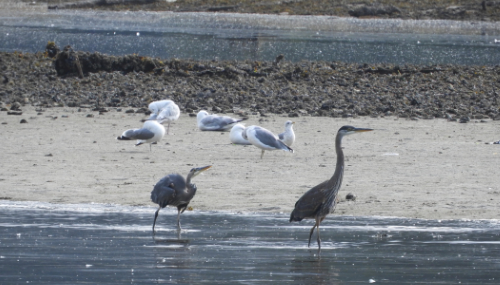
Green Island anchorage was beautiful, looking out into Fitzhugh Sound, whilst Amelie was protected by tree adorned islets with a corridor ofwater going inland to BC mainland. The only inhabitants that we could see were several Kingfishers, a Great Blue Heron and a couple of Harbour Seals. We had seen many Humpback Whales blowing on our voyage which pleased us enormously, as we hadn’t seen many this summer. Ospreys were more visible than its larger cousin, the Bald Eagle. Here we had our first thunder and lightning of the year, quite a distance away, thank goodness but a savouring thought for the out of control wildfires that were raging in BC mainland. The anchorage was very quiet and settled, a great overnighter but somehow it did very little for us for an extended stay.
The following day we motored up the sound to Kisameet Islands, off enormous King Island where there was an anchorage by an “inhabited” Indian Reservation. Once again we had views of the sound with protection from many islets, silence and calm but not much wildlife action.
Another salmon was caught, a Pink this time and Debbie made up a court bullion and poached the whole fish. Absolutely delicious and once again some more crab fodder.
Codville Lagoon Marine park nestled eight nm north of Kisameet Bay and another stopover before we enter the “humdrum” of Shearwater and Bella Bella for fuel and provisions. We had plenty of bites on the hook as we gilled around outside the pass into Codville Lagoon but everyone got away. Wi-Fi suddenly lit up, albeit feeble but we were in touch with the world again. We pottered around avoiding a few prawn buoys in over 80 metres of water and lowered our crab trap from Amelie in far shallower water off a rock strewn beach. We need a little more practice at this manoeuvre. The anchor took a while to hold, what sounded to be a rocky seabed but once settled we relaxed.
By early evening and the following day the lagoon felt like Piccadilly Circus, with comings and goings of various craft. The silence was shattered but they like us had come to enjoy this picturesque place. We can share but some manoeuvred very close to our crab buoy. The “bitch wings” and glares were at the ready.
Fuelling was necessary and we were close to Bella Bella and Shearwater, villages that were 4nm apart. We chose Shearwater as we could take Amelie alongside the fuel dock and what a welcoming reception we received from smiling Courtney, a beautiful, sociable Heiltsuk Nation young girl. She gave us tips on where her family hang out in Qye, so far we haven’t located this place. In the short time we were there, she disclosed the sacred Chiefs burial grounds on a nearby islet and encouraged us to take a ecotour with the clan to visit the petroglyphs. A business woman in the making.
We anchored just beyond the log breakwater protecting the small marina and active boatyard, called Kliktsoatli Harbour. Shearwater was named after HMS Shearwater, a royal naval vessel based on the BC coast from 1902-1915 then transferred to the Royal Canadian navy. Shearwater was originally developed as an anti submarine bomber reconnaissance base from 1941-1944, and then became the Canadian Airforce’s seaplane base. The hangar houses the marine supplies and limited supermarket. Along one of the walls is a huge mural depicting the images of seventeen people who had been involved in the growth and development of Shearwater. Overlooking the bay are memorials to the local veterans during the war. Shearwater today is a wilderness and eco-tourism destination.
The provisioning was sparse here so we launched “M” and sped over to Bella Bella (Waglisla), a thriving Heiltsuk village within an Indian Reserve. Waglisla is translated as “river on the beach”. The current village site began in 1898, after the old site (Old Bella Bella or Qelc) became overpopulated. The fuel dock here was semi submerged, the main pontoons were in disrepair, blood splashes suggested someone had tripped up, lots of ecolodge ferries collecting guests with their luggage but the new supermarket was a nice find. The produce was also sparse but we managed to cobble together an improvised collection of fresh goods to keep us going for a while. No shops where we are going.
A slow motor to rendezvous with Jim and Peggy on M/V Carisma in Rescue Bay, doing a spot of fishing along Oscar Passage, the skipper desperate to hook a salmon in his grandson’s name. We turned the engine off and allowed the minimal wind and current to glide us towards our destination in silent mode. We were rewarded by a Humpback Whale very close to Amelie, appearing to be resting on the surface, blowing occasionally and then smoothly diving into the grand depths. Research suggests whales can sleep or rest, blowing and diving whilst slumbering.
Rescue Cove is huge and became quite popular, all of five boats! We were excited about meeting up with our friends again and spent an evening gassing, eating and drinking. The following day together we mooched into Fiordland Conservation area, established in 1987. Amelie, crew and Jaz had been here before and had the most magnificent bear and whale experience. We passed the magnificent waterfalls in Kynoch Inlet, watching out for logs, our visibility being slightly hindered by the smog.
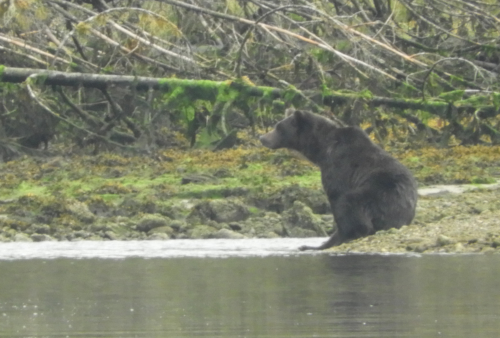
Seven years to the day we anchored in Mussel Cove and immediately sighted an enormous bear frolicking in the marshy grassland at the head ofthe bay. The salmon had started to enter the bay in numbers, huge, gnarly fish ready to lay their eggs and end their days in the stream that they were born in. Gigantic splashes with airborne salmon were a treat for the many seals that spent the afternoon chasing them around the boats. Bald Eagles were perched on the low lying bank munching on fresh juicy salmon. The four amigos in their dinghies, travelled slowly up the creek and quickly sighted a young swimming Grizzly Bear. He/she was aware of us and constantly checked us out but we maintained a steady photographic distance. Several times the bear hauled itself out of the water, slowly plodding along the bank and the final time it glided into the water, gracefully dived and came up with a twitching salmon. We witnessed the bear patiently eating its fill, whilst gulls surrounded the juvenile Omnivore waiting for the fleshy carcass remains. The bear appeared not to be bothered by the birds and left them a huge tasty supper. As the bear walked the worn path along the bank, it stilled looking towards the head of the tributary. Binoculars swung in the direction and a huge Grizzly lowered itself into the water and swam effortlessly towards the bank. Were we going to witness a standoff, a fight or a retreat? The massive bear went to the edge of the bank and the smaller bear greeted the older bear by coming face to face. After a silent greeting, the smaller bear meandered off into the tall grass and out of sight. The larger bear continued swimming, also diving and catching a salmon, taking it out of our line of sight.
What a privilege to see this and Mussel Cove, once again, offered us glimpses of its riches.
This year the mosquitoes, bugs and horse flies had been minimal but Mussel Inlet made up for it. Constantly we were swatting and being bitten, even the wind didn’t deter them. The plastic fly swatters were disintegrating from over use.
Alas the following morning the wind funnelled down the inlet, creating waves and gusts of over 20kts, time to move out. We motored for several hours until we reached Windy Bay, which was calm, (despite the name) enjoying the company of Peggy and Jim, sharing food, drinks and boat space.
Very little to see here as the stream was blocked by massive boulders and very few salmon were spawning here.
We up-anchored and ended up in Kynoch Inlet, (known as the crown jewel of Fiordland) staggeringly beautiful, once again with steep granite (several thousand metres high) mountains and extremely deep water. Anchoring went well once we found a suitable depth, at times too deep and then far too shallow. We saw 2 metres under the keel at one stage, dropping suddenly. Both boats anchored off Kainet Creek, which has reportedly silted up, amongst the towering remnants of glaciers, of which some had snow present in the gullies and peaks.
Kynoch Inlet is the historic homeland site of the Xai’Xais First Nation people, who moved to Klemtu in 1875 to join up with the Kitasoo Nation, after both nations being decimated by diseases from the Europeans.
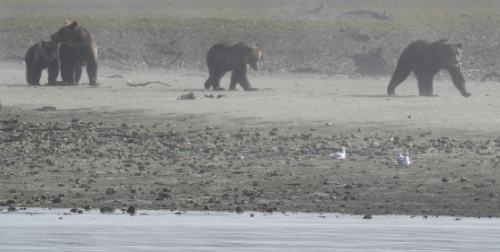
This area was a “Bear Bonanza” experience. We constantly saw Grizzly Bears of all ages, sizes, colours and sexes, foraging, swimming, playfighting, cantering and rolling in the wet grass with their huge fluffy paws stretching to the sky. One sow had different aged cubs with her. She was enormous and blonde coloured, catching a big salmon for the youngest, who had it stolen by its older sibling. This well fed smaller cub had no qualms about retrieving it off the bigger cub. Mama Bear sometimes wrestled with her cubs and when she’d had enough, aggressively swiped the older one and tugged the ear of the smaller cub. She allowed them to crawl over her, a very tolerant and attentive mother. Our breakfasts were delayed by these sights and one day we had lunch while viewing this family of bears fishing.
In the rain, we joined Jim and Peggy on their tender and entered the Culpepper Lagoon at slack high water. The lagoon is beautiful with evidence of many waterfalls, which flow in the spring after the winter ice melt in the mountains.
Using “M”, Jim and Amelie crew decided to check out an anchorage 5nm away, Desbrisay Bay. We felt tiny compared to the soaring mountains, many scarred by the receding glaciers, with minimal growth of any greenery and some looked as if they’d been roughly moulded in clay then thrown on either side of the water. Reading suggested that receding glaciers polished some of these mountains, giving a dark, shiny look. This anchorage with drying flats seemed devoid of spawning salmon and therefore bears, eagles and other bird life. We were anchored in the best place for a wildlife extravaganza.
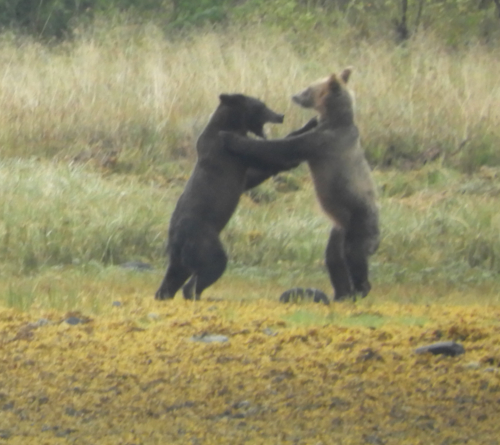
The decision was made to stay another day, as the salmon were spawning in increasing numbers, possibly related to the full (Blue) moon and the extreme tides. The day started with thick fog wafting down the steep mountains into the inlet but as it cleared, the drying flats were just over 100 metres from Amelie. Lo and behold, the familiar family of bears slowly made their way just off Amelie’s stern, unaware that we were there or maybe they didn’t mind us. The two older cubs scrapped with one another, making friendly growls and the chubby, fat faced cub stayed close to his mother. We were able to see their long sharp claws as they dug in the wet sand, possibly hunting for clams. One large cub found a drying rock and scratched an itch with facial expressions that suggested pure bliss. Privileged, honoured, breath taking, wow factor, didn’t touch the emotions that we were experiencing. These graceful creatures dominated our morning, disappearing into the misty forest glade as the tide slowly came in. This felt like the pinnacle of our summer but we still had two more months of exploring and catching up with friends.
Our last evening with Peggy and Jim came too soon and we parted ways in Bottleneck Cove, Roderick Island. The scenery had changed from towering mountains to rolling tree clad hills, the smell of pine lingered in the air after the overnight rainfall and then warm sun in the afternoon. This cove was sacred as it was used for crabbing for the First Nation people for food, social and ceremonial activities. We were forbidden to crab here but we enjoyed the beauty of our surroundings.
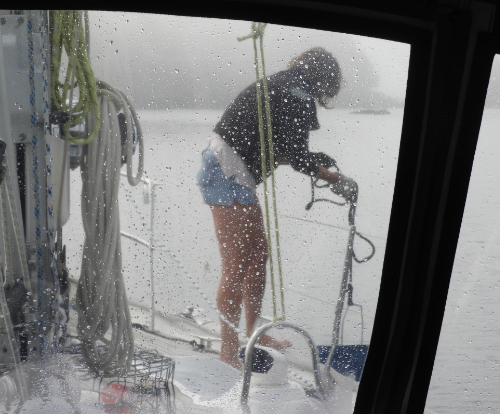
Rain stopped play for nearly two days.
The rain was replaced by warm temperatures and blue skies. We ventured out along Finlayson Channel, dodging tree trunks in the glassy sea, traversing Moss and Perceval Narrows with our destination in Oliver Cove, on the mainland. The scenery was spectacular, low lying compared to Fiordland, craggy islets with the Pacific swells entering some of the exposed areas via Milbanke Sound. Amelie rolled gently with the swell towards our peaceful anchorage.
The tranquil setting got better and better. As the early evening arrived, the light changed bathing the surrounding rocks, trees and beaches in a warm golden glow, followed by a star clustered night sky, with the sound of the Pacific constantly moving not far away. This cove had a magical quality to it, we were spellbound.
Fishing beckoned the skipper and we spent a pleasant afternoon, motoring slowly along the rocky headland in the general direction of Shearwater and Bella Bella. Bingo…..a sea harvest of Rockfish and a Chinook salmon.
We spent our 21st wedding anniversary in Shearwater with strong gusts and lots of rain. Nevertheless we celebrated in style in our beautiful home.