

It is claimed that Bora Bora together with Maupiti are the oldest of the Society Islands, around seven million years old.
Bora Bora has several ancient names, Vavua (looming from darkness) and Pora Pora mai te pora, meaning first born and created by the gods, the first land to rise from the water. The first settlers arrived in the ninth century. It is understood that the name, Bora Bora, came from the first Europeans to alight on Bora Bora soil, Jacob Roggeveen in 1722, when he misheard the pronunciation of Pora Pora.
James Cook visited the island in 1769, using the navigational expertise of a Tahitian, Tupaia.
The London Missionary Society arrived from 1820 and destroyed most of the archeological sites, building churches and missionaries on the sacred foundations. Prior to Cook visiting the islands it is said that King Firiamata O Vavau brought peace to this tribal warring island. He was a man of legends, a highly accomplished navigator and respected as a supreme warrior. The Bora Bora warriors were a fearsome bunch and terrorised Raiatea and Taha’a until the French annexed them in 1888 by forcing the then Queen Teriimaevarua III to abdicate.
The typical pattern of the missionaries altering the Polynesian culture occurred in Bora Bora as it had throughout the Pacific and the next big historical event followed the Japanese bombing the US fleet in Pearl Harbour, Hawaii in 1941. On February the 17th, 1942 an armada from Charlestown, South Carolina arrived in Bora Bora, known as Operation Bobcat. Bora Bora became the US naval military supply base for the Pacific. During the next four years 6,000 men were based here building an aerodrome on Motu Mute (now the airport), oil depots, roads, water supplies and defensive fortifications. The base officially closed in June 1946 without seeing any Pacific action. Military artefacts, as described in our Oyster World Rally blog, still exist slowly being engulfed by the fast growing vegetation. Only one of the eight massive guns remains which had defended the only pass, Passé Te Ava Nui.
Since 1946 the island’s economy had relied on copra and vanilla production for export but in 1960 Tahiti opened it’s international airport and the inter-island flights have increased, tourism has now become the number one money maker.
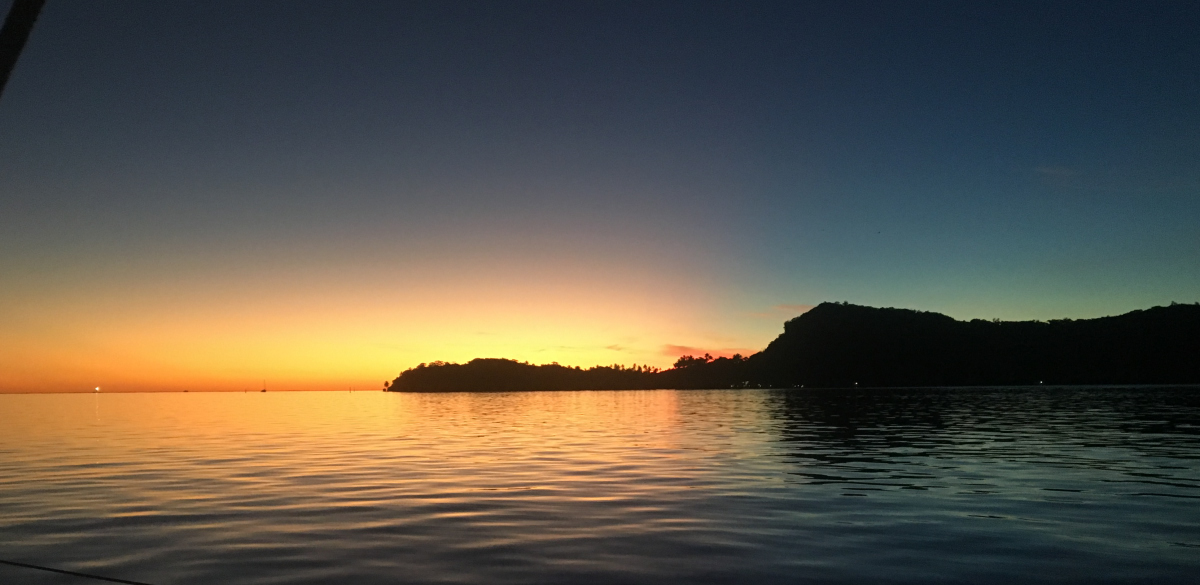
The iconic shape of the island is seen from miles off, dominated by the remnants of an extinct volcano rising to two peaks, Mounts Otemanu and Pahia, highest point at 727 metres. These peaks overlook a multihued lagoon, surrounded by a reef. Surprisingly Bora Bora is not a particularly large island but despite the huge amount of tourism, it has maintained a certain chilled charm. The main village on the island is Vaitape with the most pearl shops we have seen in such a small area. Cruise liners appear most days but it doesn't detract from the beauty of the island and lagoon. The shop keepers are tourist savvy, coming across as tolerant and maintaining overall the Polynesian friendliness.
We initially anchored in Faanui Bay, not far from the American Wharf, built in 1942, where today the various supply ships offload their cargo. The following day, after refuelling we anchored between Motu Toopua Iti and Matira area of Bora Bora. We had been warned that we may find anchoring prohibited in Bora Bora but our experience was fine. The local tourist and reef fishing boats happily acknowledged our presence, always waving happily to us. Various official boats randomly patrolled the area and didn't have any problem with us.
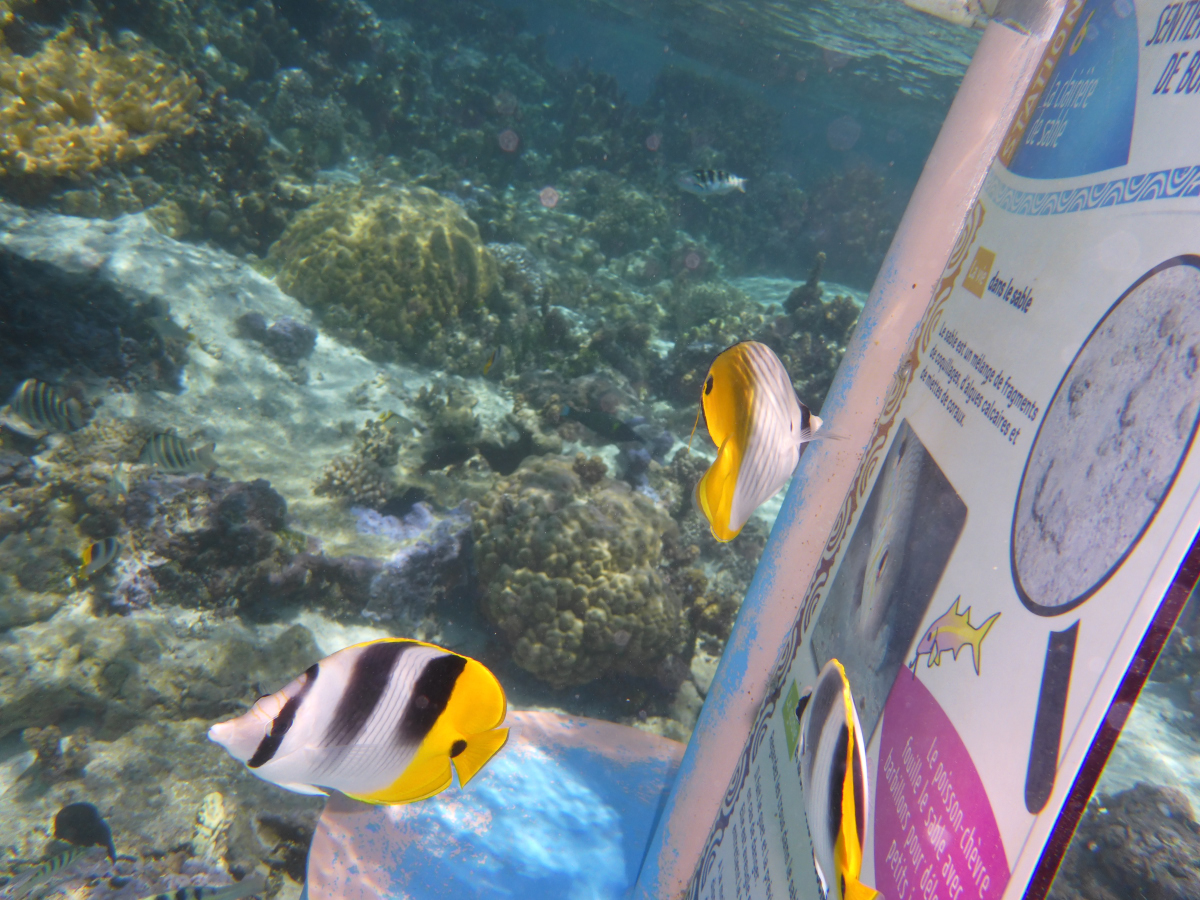
The clarity of the water here was unlike anywhere in Polynesia, even the fish had shadows on the seabed, often with us being many metres above them. The sighting of Tahitian and Eagle/Bat Rays was constant and the odd turtle was seen swimming the depths. At one stage during Debbie’s SUP adventure, she saw a fever of Eagle/Bat Rays, one of which glided alongside the board. The fish do not appear to be nervous of humans and we have some knowledge that they are fed by the tourist boats. The pair of us have mixed feelings about this. Our favourite spots were near to Motu Piti Ua Uta and by the reef edge of Motu Toopua. The latter has the most spectacular coral area, mostly in good health with buoys with hand and foot holds so you can rest and read underwater signs about the immediate vicinity. Certain fish have developed characteristics that suit different shapes and types of coral for fish protection, food foraging and cleaning stations. We heard about these two sites by word of mouth, there is very little written information, maybe to encourage visitors to use the many tour operators on the island. As the sun sets over the Motus we often hear aggressive fish predator activity close by Amelie. The huge splashes and cauldrons of swirling water, after an attack, keeps us alert. No swimming for us after the sun goes down.
“M” was used many times during our stay including a circumnavigation of the main island. The various aspects of the twin peaks changed at every angle, naturally we took loads of photographs.
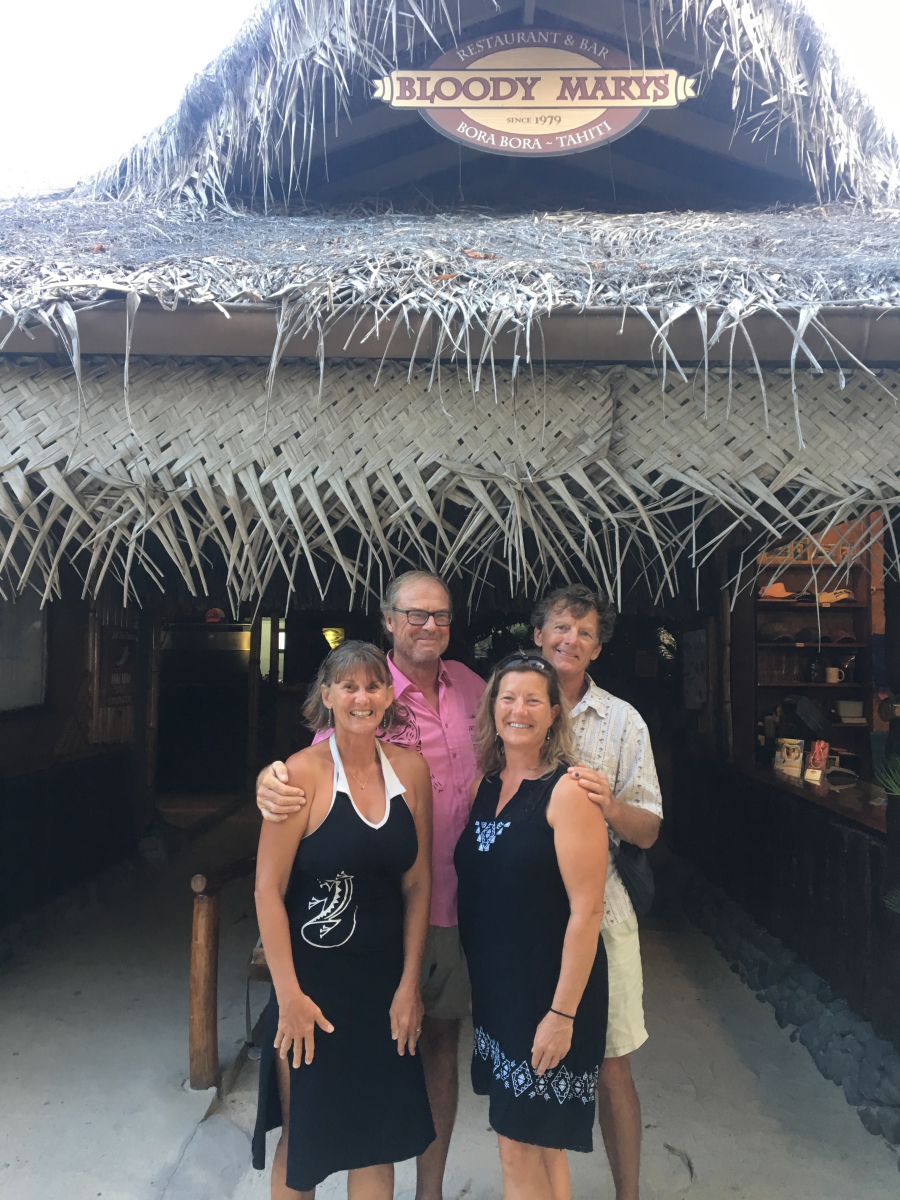
We couldn't leave Bora Bora without a visit to Bloody Mary’s. On the OWR we had a fantastic party there, drinking the bar dry, dancing on the sand floor and Stephen’s “Marilyn Munroe” moment with his pareo. Together with Dave, Sheila and Eric from Shorleave we had a ball in 2019 and ended up drinking “Bloody Mary's” and eating barbecued fish sitting on the mushroom stools. The penis hand pull is still highly polished in the men's washroom, Sheila and I checked!
We met Dave and Sheila from Shorleave in the Marquesas, probably walked past them in La Paz in Mexico without knowing and over the past year we have spent time together in various islands. As a foursome we have developed a very close relationship and typically it was very sad to see them sail off in to the sunset, on their way to Tonga and then New Zealand. They are “special” friends and we had the pleasure joining their family, Shawn, Cory, Alison and Evan over the Christmas and New Year holidays. Laughter always rang out from our boats and the youngsters kept us lively, not that we needed much encouragement. We are already missing them like mad but we have promised to meet up either in New Zealand or back in their hometown of Vancouver.
The title of this blog was found in a tourist guide but for us this describes the underwater experience here. The large resorts did not effect our stay as they are nestled on their private motus and are quite beautiful, being built from natural products from the islands. It isn't as noisy as Moorea who at times have issues with loud music played on the beaches.
Bora Bora is an elderly gem and once again we have enjoyed every moment here.