

We diverted to Malcolm Island, spending time salmon fishing, still nothing to put in the pan. Everything we had read and friend’s recommendation sent us to the town of Sointula and we anchored under overcast skies in Rough Bay. We assumed the name was appropriate in certain weather but it was calm for us, although littered with crab buoys.
Sointula is Finnish for place of harmony. So what is the history behind this community?
At the end of the nineteenth century after decades of political and economical upheaval in Finland, some individuals made the decision to emigrate to the North West area of America and BC. They wanted change and encouraged a socialist journalist, Matti Kurikka to lead them. Their settlement was called Sointula and their mission was to form a community of equality, sharing and all property was communal. Women were treated as equals which was a new concept in these times. They built a brickyard to build houses; a foundry with a blacksmiths shop and sawmill. One of their aims was to spread the word, encouraging Finnish immigrants to join them. They achieved this by publishing one of the first Finnish newspapers in Canada called “AIKA Times”.
The common belief within this community was “sound body, sound mind” and organised activities were held to produce this idea of utopia. Unfortunately Kurikka’s ideas and decisions were far too idealistic and he was thrown out. Following a change of leader, hardships, fire damage and financial ruin, the community sold their remaining assets to the bank and returned the island to the Canadian government. However some of the remaining souls bought some land on the island, continuing to fish and hand log. In 1909, they formed a co-operative and this remains thriving today, forming a hub for the island. People who want freedom are attracted to this island and its mentality. It is a clean, tidy, orderly area, manicured gardens most of which are fenced in using artistic flair with driftwood, cedar shingles and fishing paraphernalia. The people are friendly, wave from their cars and happy to stop and chat. There is a mixture of generations in this small village with a link to Vancouver Island via a ferry to Port McNeill. Despite being the height of the summer, there were only a few tourists like ourselves but the place seems to be thriving.
Alas it was time to move on from this timeless, serene place for a foggy trip to Port Hardy, with some fishing on the way. We were pleased that we were getting bites but so far no supper. Debbie had been sent to the hardware store in Alert Bay to buy pink lures. Basically she bought anything pink on the shelf much to the skipper’s bemusement.
The Port Hardy stop was for provisioning for the next month exploring remote parts of BC. Cigars were on the agenda but also the promise of a Sunday artisans and farmers market. Cigars were a success but the market won the award for the worst in our experience. Stephen is trying to get over the overwhelming excitement from the visit.
Present day Port Hardy town site has existed since the 1920s and only connected to the south of Vancouver Island in 1979. An existing logging road was paved between the town and Campbell River. Port Hardy is seen as a connection hub for the central coast, Cape Scott and the north coast trails; BC ferry links to the Discovery Coast and Prince Rupert. Port Hardy (for us) over the last seven years appears to be deteriorating, empty shops with their windows covered with newspaper, most buildings look tired. The main activity is at our favourite coffee/bookstore “Guidos” and the supermarket. Stephen located cigars in the back of a seedy convenience store and next door housed a fantastic fishing shop. Naturally we spent some money here.
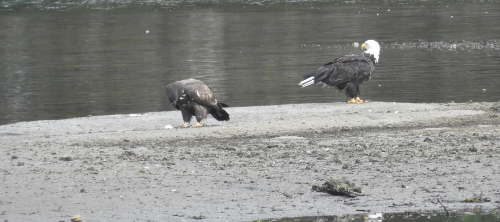
The anchorage is affected by passing sea traffic and weather in the strait, causing some bouncy moments however the wildlife experience wasamazing. Humpbacks and Grey whales blowing and breaching, Sea Otters, Porpoises, Seals, Salmon jumping and the highlight, Bald Eagles caring for their enormous chick on the dry flats close to Amelie.
Port Hardy never fails to astonish us with this type of visual experience.
Full to the gunnels we headed off at first light in a brisk NW wind, choppy seas across the strait towards Skull Cove, in dense fog. The optic nerve workout was taxing and the anxiety of locating and avoiding huge logs was tiring. Islands suddenly appeared out of the gloom, like ghostly apparitions together with fishing boats darting across our bow.
“Time to put out a line”, says an unfazed skipper.
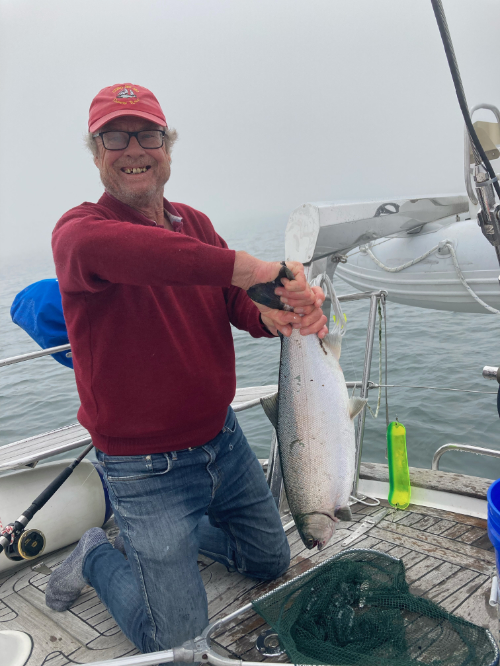
Lo and behold we caught our first salmon (Chinook) in two years using (wait for it) a pink lure that Debbie had bought. With the skipper hauling it in and Debbie hanging off the stern with the net, the other hand gripping the dinghy davit for dear life, we managed to get it on the deck. Quickly the fish was killed with Stephen’s new PINK fish whacker, bled and then filleted into eight large meal portions. The detritus was bagged and used as crab trapping fodder. Oh did we celebrate and bored our family and friends with photographs of the fish that didn’t get away!
Using “M” we did a circumnavigation of the surrounding islets and words cannot describe the beauty of this area. To this point in our travels over the past few years, this is probably one of the most beautiful areas. Forests of gnarled old trees bending over towards the water, whispering and creaking in the wind, bladder rack seaweed attaching itself to the support, waving in the currents, acting as a structure for more life, Cedar snags, tidal plains, submerged rocks raising their bulk as the tide goes down and clams squirting seawater out of the sand. Here the marine bird life is prolific. Canada Geese strut their stuff on the low water beaches together with Glucous Winged Gulls. The statuesque Great Blue Heron, unperturbed by a huge busy Raccoon rooting for clams in the sand. Common Loons crying mournfully across the bay until their water domain is invaded by the same species. Their cry turns to an aggressive constant squawk and with their wings aloft in a “V” shape, chase the newcomers away. Pelagic Cormorants sitting atop rocks in the early afternoon sun, gazing around. The frenetic behaviour of the Belted Kingfishers, hardly stopping whilst singing their noticeable song.
One morning we watched a massive female raccoon with her two chunky offspring, scavenge the low water flats. The mother went into attack mode when a heron glided down towards her babies barking aggressively at the bird. The babies scurried close to their mum and stayed near to her for the rest of their exploring.
The Northern Raccoon is also known as Coon, Raccoon or Ringtail and its Latin name, “Procyon lotor”.
They are generally the size of a Cocker Spaniel, stocky, with 4-7 dark rings along its long, bushy tail and a black bandit mask over the eye area.
They hate the cold and snow, so stay in the wetlands; shores of streams, ponds and lakes; along ocean beaches and estuaries. Raccoons prefer to forage near forested areas with their den tree habitat. This gives them cover from extreme weather, protection and escape from predators. Communal denning happens in the winter, often in family groups to conserve body heat.
These animals are opportunistic Omnivores, gatherers rather than hunters and forage nocturnal unless low tide is during daylight hours. They use their nose, ears, eyes and tactile senses to locate prey. They scurry around the shallows, using their dexterity, sensor receptors and tactile abilities to locate food under rocks by feel alone rarely submerging their bodies.
They dramatically lose weight in the winter because they use a lot of energy to stay warm and food sources and locations are not abundant.
Raccoons are more tolerant of one another than most other Omnivores but they aren’t particularly sociable, staying solitary for most of the year except for mating, rearing young or siblings staying together shortly after leaving their mother. Their tolerance is with sharing territory rather than social etiquette.
These comical critters are bluffers, often posturing aggressively, hissing and snarling if approached. They rarely attack.
Females can breed within their first year of life but the pregnancy rate is low. They mate in February through to early March, with an average gestation of 63 days, litters (on average 3-4 Kits) are born April/May time. The young stay with their Mum for up to 8 months.
Transmission of diseases and parasites are rife in Raccoons. The extreme weight loss in the winter further affects the animal’s general physical condition making them vulnerable to many illnesses. Predation is by Cougars, Bobcats, Grey Wolves, Coyotes, Red Foxes and Fishers (type of Marten). Death by road accidents in urban areas is common and in the last hundred of years or so because of fashion. In the 1920s, Raccoon coats were high fashion particularly in North America; 1950-1960s, there was a fur trade surge for coonskin hats because of the Disney TV series, Davy
We made plans to travel up Miles Inlet via the notorious Nakwakto Rapids and with no fog, we up anchored and mooched into Schooner Channel.
Why hadn’t we done our homework, as we usually did?
Firstly we were experiencing spring tides (ultra high and low tides); secondly out in Queen Charlotte Strait the wind was gusting up to 21kts; the whirlpools and gushing of water in the channel were extreme and we hadn’t even got to the rapids. Stephen hand steered most of the four mile stretch, often boosting our speed due to the opposing current. As we approached the rapids slightly early we watched the force and speed of these notorious waters. Huge logs were pirouetting and then being spat out, still spinning out of control, travelling at vast speeds. We waited for slack water and then proceeded cautiously. Slack water was an area of boiling water with white capped waves. The First Mate audibly made her opinion clear and after a while, the skipper aborted. So far so good but we failed to pull into a calm anchorage around the corner, Treadwell Bay, reassess our options, make new plans, which we normally do. Treadwell Bay is not pretty with evidence of floating homes and pallets filled with building stuff so we turned into Slingsby Channel, making a decision to go out into Queen Charlotte Strait and travel 14nm north to a new anchorage…….WRONG! The First Mate could see breaking waves at the mouth of the channel and as we approached the waves were gigantic. We still continued and Amelie ploughed her way through the Outer Narrows, with current and high winds opposing one another. Sheer madness and after, what seemed an eternity, we made the decision to turn sharp left, down the side of Bramham Island and back to Skull Cove. This was no mean feat as we had to avoid 2 metre waves smashing into our beam. The trusty skipper who is an expert helmsman took the wheel and manhandled Amelie to safety, surfing down massive waves and getting us into safe waters, anchoring in a sheltered spot. Further reading regarding this area, added to the terror that the First Mate had experienced and the skipper remained nonchalant. Slingsby Channel is the main drain for estimated hundreds of miles of inlets beyond the Nakwakto Rapids. Imagine this quantity of water erupting out of the Outer Narrows colliding with Pacific Ocean swells, added to that, gusts over 20kts of wind. We scuffed up and it was a lesson to us, to delay if necessary and read the manual!
Kayaking was a must in Skull Cove. We flew around at high tide but the low water kayaking was amazing, certainly more challenging but the views above and below the water kept us dazzled.
Water making was vital and the skipper wanted to do some fishing, so we left Skull Cove in the fog and played dodgems with rocks, islets and other fishing vessels, often not seeing them until we were a couple of boat lengths away. The navionics programme is worth its weight in gold and we were safe despite being blind. An enormous sea otter passed us by, unperturbed by our shadow, staring at us while lolling on his/her back.
The Sea Otter (Enhydra lutris) is a member of the weasel family but its large chunky body is more associated to that of a seal, with its mini fore limbs, hind feet shaped like flippers and short tail. It is entirely aquatic being very clumsy and ungainly on land. This beautiful mammal rests, eats and swims while floating on its back; hunts, fights, breeds and often gives birth in the water.
It cannot be misidentified with the River Otter, they are totally different looking animals plus the Sea Otter only lives near the shoreline or shallows of the North Pacific Ocean and the Bering Sea. They have been recorded as going ashore generally because of severe winter storms, illness, injury and very occasionally to give birth.
Foraging occurs on the ocean seabed over a period of twelve hours, diving on average for 55 seconds a time. They enjoy a diet of sea urchins, crabs, abalone, clams, other molluscs and bivalves, using tools such as stones and large shells to break into the nutritional part.
Death is often due to starvation or Enteritis. Food deprivation is often of the Sea Otter’s making, as it tends to decimate its food sources. Hunters who were after the same food source for their own needs or to make money, hunted them to near extinction last century until they gained international protection in 1911. The fishermen continue to see them as a nuisance.
Predation on Sea Otters is primarily by Orcas, followed by sharks and Bald Eagles, who prey on the pups.
Females reach sexual maturity at three to four years of age, having litters of one live pup, which are self sufficient by six to seven months. Delayed implantation is common in Sea Otters and gestation is around 7-9 months. The mating pair stay together for 3-4 days and if successful the pups are generally born between April and July.
An interesting fact about these mammals is that they have an insignificant layer of blubber and their dense fur acts as insulation and water resistance. This is only successful if the fur is clean, so Sea Otters spend much of their day grooming.
The wind generally picks up in the afternoon in these parts so we headed for safety in Allison Harbour, a picturesque lengthy inlet with “bear beaches” on both sides. As we reeled in the fishing line to anchor safely we discovered a flailing tail fin following the lure. Unbeknown to us we had hooked an Albino Chinook, (white rather than pink/orange meat) another tasty supper, extra for the freezer and the left over bits went into the crab trap, as it is recorded as good crabbing in this harbour.
Allison Harbour hid most of her beauty around from the anchorage up a creek, that eventually became silted and blocked with fallen trees. Majestic views of rugged rocks, topped with old forest, no evidence of commercial logging here. The silence was punctured by the odd high pitched rattle from the angry kingfishers, telling us off for being in their territory or a sweet song from an unidentified bird wafting through the swaying trees. We felt as if we had been transferred into another world by a water portal.