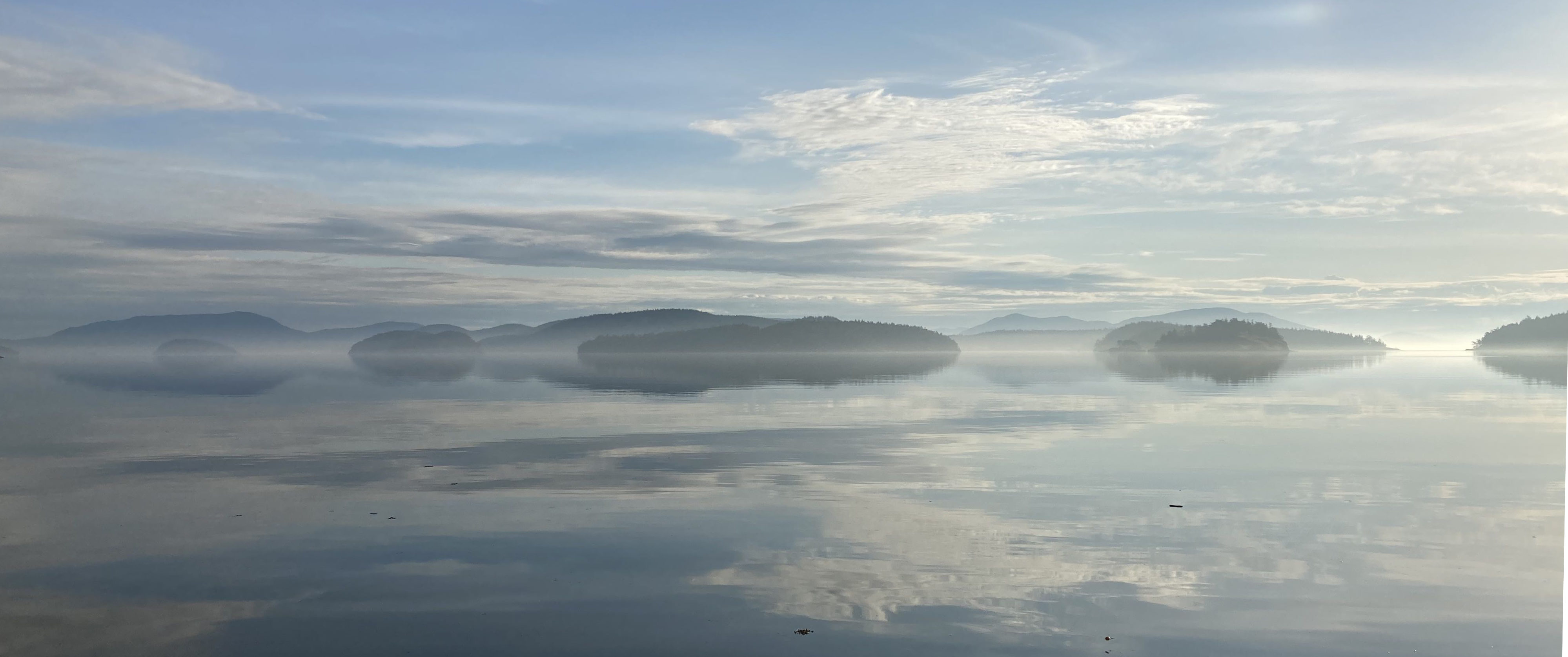
Amelie and her crew left Port Townsend after a celebratory party the night before and woke at some unearthly hour to catch the tide. Few others were out on the water, apart from the odd working vessel on a biting cold morning in early December.
Full of espresso coffee and hot bacon rolls, Amelie’s improved engine soldiered on towards the Canadian border. The day proved to be dry, with blue skies and fluffy clouds and we made it to the marina in Victoria before dusk. Prior to this, friendly Customs and Border patrol officers visited Amelie on the designated custom dock to check our papers, health declaration and covid vaccination certificate with a negative covid test status and swiftly agreed to our entry and produced our cruising permit.
Stephen squeezed Amelie into a tight berth and over the following week we reacquainted ourselves with Victoria, organised the dreaded Wi-Fi (which proved to be relatively uncomplicated) and Canadian telephone number, attacked some boat chores and generally settled in to winter mode.
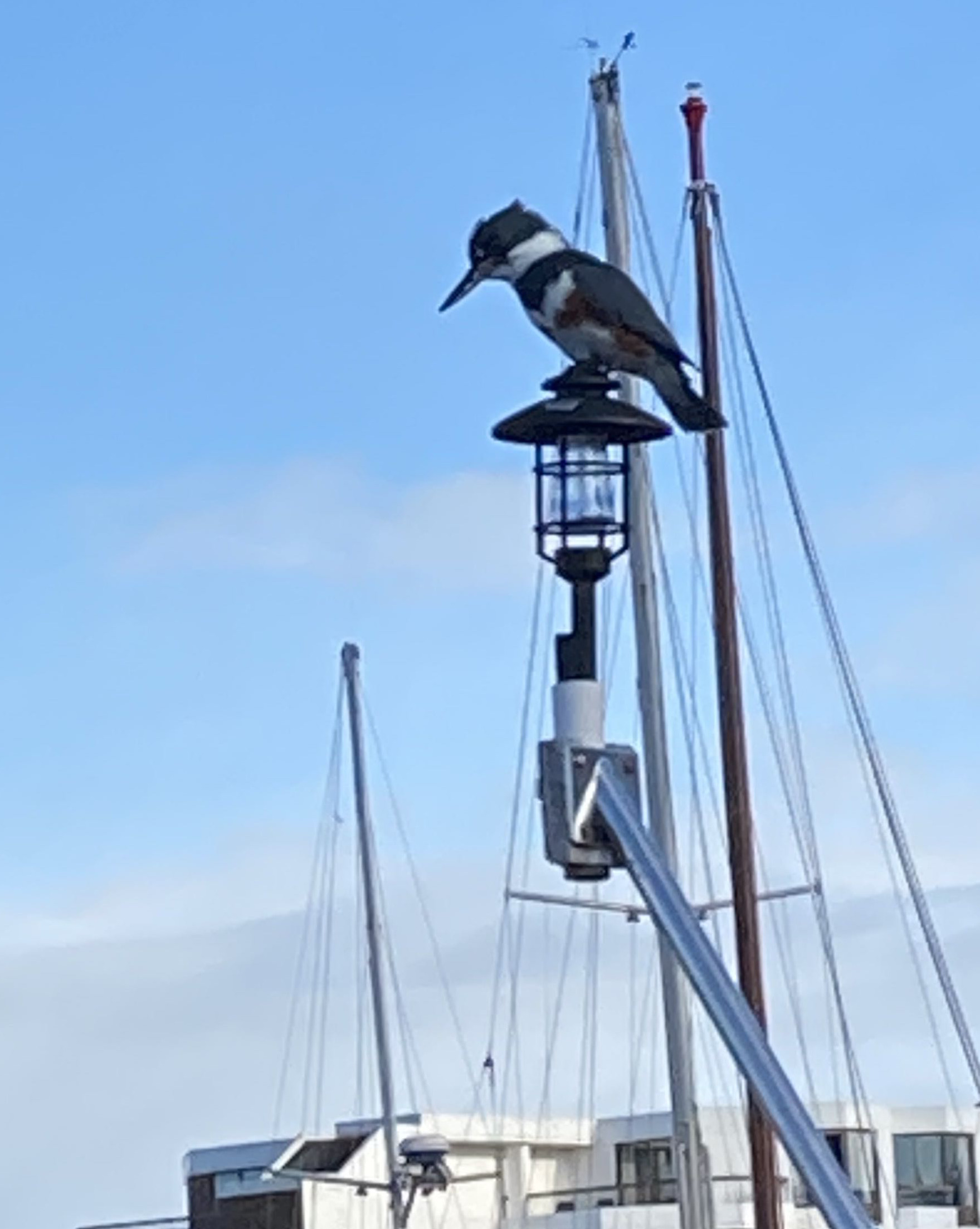
Immediately we noticed the huge amount of wildlife on the pontoon, with a busy Belted Kingfisher fishing from the boats. He was a handsome chap (turned out he was a she) with a blue/black Mohican and red waistcoat. 100% success rate on the fishing stakes. The second evening we had the most enormous river otter attacking a crab, leaving only the carapace for the scavenger ravens. Playing hide and seek, a giant harbour seal was fishing nearby and warily lifting it’s huge head to gaze at us before disappearing into the murky depths. He repeated this exercise over and over again. At a later date, whilst walking along Fisherman’s Wharf we saw a seal begging for scraps from the recently returned fishing fleet.
The highlight of our first week was a visit from the Wright family who we met in French Polynesia. Non stop chatter, drinking, eating and then we ended up in a board game cafe until midnight. Fantastic fun and loads of laughter with plans made for us to visit them in Vancouver.
Slowly news filtered through that Canada were imposing social gathering restrictions regarding the Omicron variant, our circle of life would soon be back to the two of us again. Furthermore the weather was getting colder and colder, with the forecast of a white Christmas. Walking back from the birthday meal on Christmas Eve we were lightly covered in powdered snow and by Christmas Day evening it was settling. Freezing temperatures meant the dock water supply was switched off and we relied on our full fresh water tank for the next ten days. Amelie transformed into a snowscape and our heating just about managed. Welcome to the northern hemisphere winter, magical but ten days was enough.
During this time we entertained ourselves by watching lots of downloads, jigsaw puzzles, reading and the odd trip out. On Boxing Day we visited the mediocre Orca exhibition at the museum. The highlight was the Humpback whale documentary at the imax. We feel humbled that we have witnessed the Humpbacks behaviour in their natural habitat and hope to see more in 2022. During the festive period, the bell tower outside the museum played Christmas carols. This aperture is known as the Netherlands Centennial Carillion, a gift from the BC Dutch community. The structure holds 62 bells which toll every 15 minutes with a tune on the hour. This carries on throughout the year.
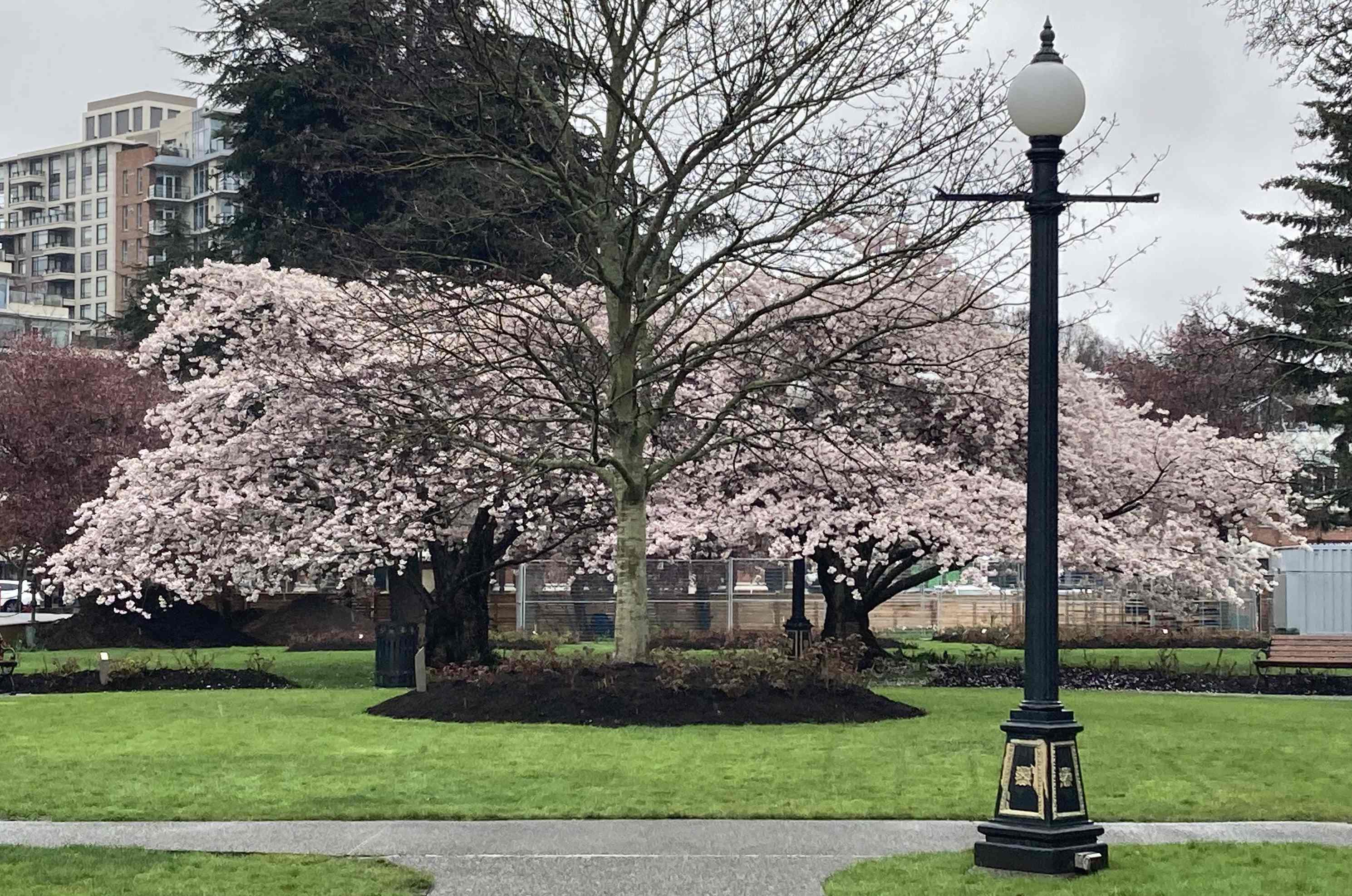
Throughout January we alternated inside and outside boat projects according to the weather. February came and went in a flash but we experienced the first signs of spring with the Cherry tree buds filling the air with their heavy aroma. Stephen celebrated his birthday in style, mainly food related, starting with a hearty breakfast at Floyds and ending his celebration with supper at Il Covo, an Italian restaurant across the road from the boat. A downhill walk after a feast and sharing a bottle of Amarone.
We were fortunate to meet up with Ian, Susan, Tony and Coryn who looked out for us the last time we were here. Lively conversation without being boat orientated was wonderful and made a pleasant change. Maureen and Doug from Nanaimo drove south to visit us and celebrate Maureen’s retirement from teaching.
Slowly Canada eased the covid restrictions and we were able to meet up with some of our dock dwellers. Brad who resides across the pontoon from us makes us feel exhausted by his energy. During his free time he free-dives, spear fishes, cycles, surfs and kite boards. One Sunday he caught a Cabezon (Scorpaenichthys Marmoratus) of a good size. Cabezon is a Spanish word meaning “stubborn” or “big-headed”. The head was huge compared to the rest of his body. They can reach up to 25 pounds, this one was approximately 10-12lbs. It is a scaleless fish, with eleven spines on its dorsal fin. The mouth is broad with many small teeth. This one was a deep claret colour but they can be brown or green. It is claimed that 90% of red Cabezons are male. Brad had to fight off the seagulls and otters while he filleted the fish and kindly gave us the tail end. This was a first for us and the taste was exquisite, quite a meaty fish with a subtle flavour. They feed on crabs and this is what makes their flesh taste so sweet. Cabezons are native to the Pacific coast of North America and are the only known member of its genus. They have a lifespan (unless they’re eaten) of nineteen years. The eggs (roes) can be potentially toxic if ingested. They live on top of rocky ledges, close to the seabed waiting for crabs to mooch in their direction.

March proved to be a busy month with Stephen getting ready to fly to Nuku Hiva to help Paul from El Mundo sail his beautiful 56 footer to the Pacific North-west. We envisage that Stephen will be gone for 6-7 weeks, anything sooner will be a bonus, leaving the “real” skipper behind to look after Amelie. During this time, Jackie will fly in from the UK for a two week visit, which will be fun with lots of exploring as tourists. Meanwhile Amelie will have a “Debbie” make over and poor Stephen won’t find a thing when he returns.
Our plan on Stephen’s return is to sail over to Port Townsend to collect our long awaited anchor chain, spend a few weeks in the islands and then set off up the inside passage, catching up with our friends from Vancouver then returning to Victoria for the winter again.
Whilst Stephen was away doing his intrepid explorer stuff, including being a gooseberry at our friends’ wedding anniversary dinner, Debbie was out and about enjoying city life.
A highlight was a walking historical/food tour of Downtown Victoria. What she discovered during this tour was not written about in the guide books.
Victoria became British Columbia’s capital in 1871 and to enhance its look, the fetid swamp strewn with city rubbish, James Bay, was dammed up, now forming the Inner Harbour and causeway. The bay was filled with gravel with the intent of planting a huge garden. The Canadian Pacific Railway (CPR) wished to build a hotel on the site to welcome its passengers on its Empress steamships travelling from Asia. The hotel was designed by Francis Rattenbury, the same architect of the Parliamentary buildings. This hotel remains a tourist attraction in its own right.
Tourist drivel: the hotel is sinking 2.5 cms every decade because of its foundations; after a $65 million refurbishment including removing the ivy to perform masonry restoration, a hoard of beads, bangles and baubles was found in the twisted foliage. It transpired that as the hotel previously lacked air conditioning and during warmer days, guests would open their windows and a family of raccoons would pilfer there gaudy coloured gems. Alas members of staff over the years were punished on suspicion of them stealing the various items.
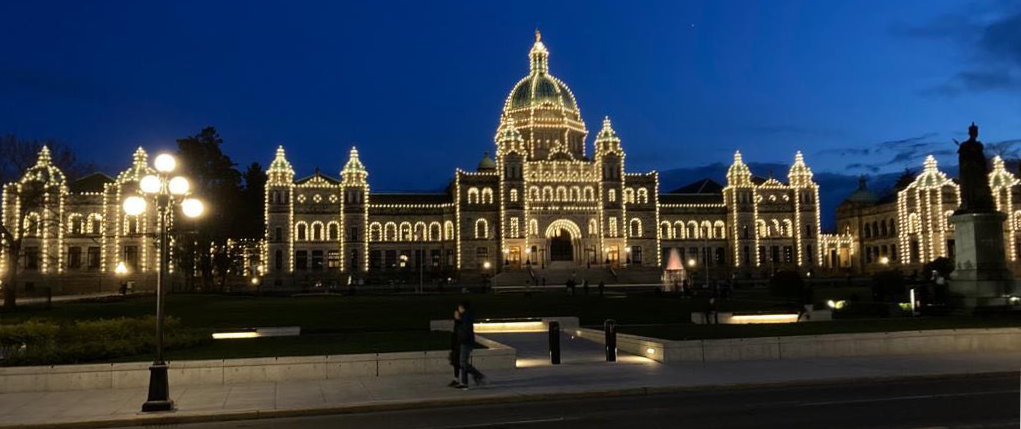
Another bunch of silly facts is regarding the Parliamentary buildings. Firstly the frontage facing the Inner Harbour is actually the rear of the
building. A statue of Queen Victoria (of whom the city was named after) dominates the front (back) lawn. At the top of the dome is a statue of Captain George Vancouver, a British Royal Naval officer who explored and charted the Pacific Northwest between 1791- 1794. Allegedly the story goes that the statue was cast in copper, hauled to the top but over time the piece turned green. This was not acceptable. Vancouver was brought down, coated in gold leaf but unfortunately when replacing him to his lofty spot, his right foot was knocked off. Alas the sculptor (Albert Franz Cizek) had destroyed the cast, so a replica of his left foot was taken and he now gazes over the city with two left feet.
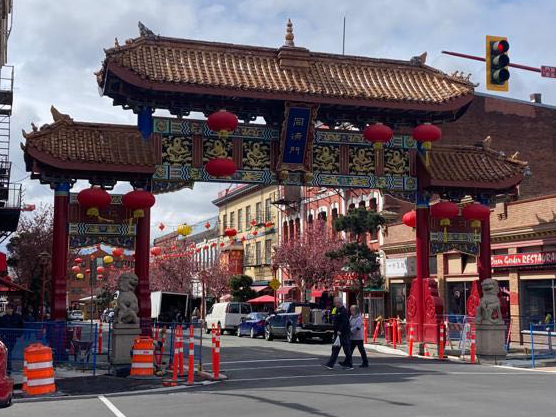
Chinatown (Forbidden City) in Victoria is the oldest Chinatown in North America. The entrance to Chinatown is via an ornate red and gold gate called “The Gate of Harmonious Interest”, guarded by granite statues of a male and female lion, weighing three tons a piece. The female lion cradles a cub and the male carries the world. These statues were gifts from Victoria’s twin city, Suzhou, in the province of Jiangsu, East China. On the top of the gate is a bottle shaped gourd embellishment, which is a charm in order to protect against evil spirits.
The buildings of the town are in red brick, with extremely narrow alleyways between the dwellings. The famous public alleyway, FanTan Alley is named after the Chinese gambling game, Fan-Tan. This lane is the narrowest street in Canada, at its narrowest point it measures 0.9 metres (35”). It was originally a gambling district and the home of opium dens with L shaped routes off the main thoroughfare. These routes were escape exits for when the police attempted to raid the nefarious establishments. The club and den owners were alerted by watchmen who used peepholes in the walls and operated wooden doors or iron grilles to block off both ends of the alley. The doors and grilles have gone, but the peepholes and escape routes are still there.
Red is the symbol of prosperity in the Chinese culture and this vibrant colour lights up this small district, contrasting with the spring blossoms of the magnolia and cherry trees. Spring in Chinatown is normally two weeks behind the waterfront with the eruption of blooms, basically because the area is so sheltered. The Chinese Public School is very red and oriental looking building, with the serpent tails at the corners of the various levels, warding off evil intent. This school was built and opened by the Chinese in August, 1909 because of a law banning children of Chinese descent attending public school. Nowadays it is open to all after regular school hours and Saturdays to learn Mandarin and Cantonese and functions as a cultural centre.
Market Square, in the Old Town, on the edge of Chinatown is accessed by a corridor decked by the original 100 year old boardwalk. This three-levelled area was built in the late 19th century and used as a market to buy and sell animals and produce. The old animal water fountain remains in situ, with a higher bowl for cattle and lower bowl for pigs. In 2022 it is used as a watering hole for humans! Today it is one of the trendy parts of town with bars, restaurants and designer goods shops. In warmer weather the central courtyard bustles with live music and festivals. Johnson Street which is on the far side of the square was the red light district for visiting sailors, lumberjacks and whalers. Busking, nowadays, in the city is not allowed without a government issued license after a torturous interview. Many street performers ie Darth Fiddler (exuberant Darth Vader clad figure) and the Scottish bagpipe playing gentlemen have been performing for years and are part of Victoria’s interwoven tapestry.
Rogers Chocolates, founded by Charles “Candy” Rogers (a greengrocer) in 1885, is a much visited historical site in Victoria. He originally imported chocolate from San Francisco but then started creating his own, a Victoria Cream. His chocolate became so popular that he gave up his greengrocers and moved (1903) across the road to the present day store in Government Street. He was Canada’s first chocolatier and the story goes that Queen Elizabeth II apparently enjoys Rogers chocolates, receiving vanilla creams on her birthday and Christmas. The shop frontage and interior are in the original state including the peephole that the paranoid Rogers used to spy on his customers and staff with an original cracked glass display cabinet. Traitors that we are, we still prefer Purdy’s hedgehogs, a chocolate store founded in Vancouver 110 years ago.
Victoria Public Market is another historic building, the original Hudson store (Hudson Bay Company). It highlights local products and food industries. A foodies paradise and where the city food tour commenced. The space oozes a community spirit with a mixture of aromas from the various eating and coffee roasting establishments.
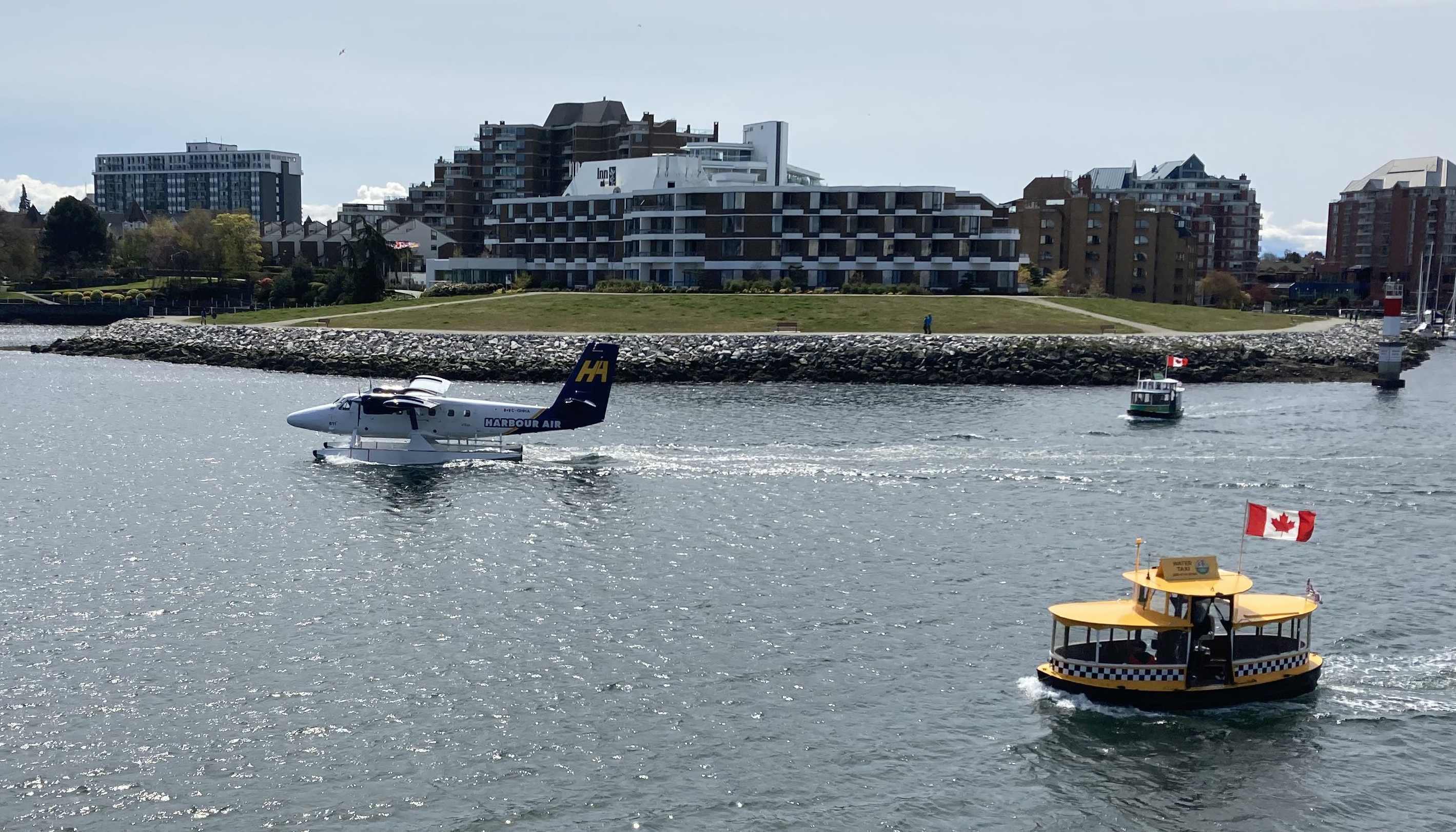
Jackie arrived for a two week stay aboard the good ship Amelie and we became glorified tourists. We used the harbour taxis (Pickle boats as the green ones resemble a dill pickle) as well as our legs to soak up the delights of this beautiful vibrant city. Jackie hired a car for a few days and we managed to get out of town and explore the west and east coasts of southern Vancouver Island, driving across the inner part in a snowstorm.
The Parliamentary building official tour was interesting, Buchart Garden captivating, Abkhazi Gardens and tearooms were worth waiting for, Ladysmith, Chemanius and Mattick Farm were disappointing, but a day trip to Saltspring Island with Susan and Lynne was a treat. The girls found cocktail bars, great restaurants, breakfast joints, consequently spending very little time at home. Decadently a trip to Vancouver was planned, flying out by helicopter and returning by seaplane. The added bonus was our special friend, Sheila joining us in Coal Harbour for a riotous lunch. Jackie’s final day was spent cruising around the gorge in the floating steam hot tubs, cocktails at The Empress and supper at Fiamos. Alas all good things have to come to an end, much to the delight of the credit cards, with Jackie flying home to her family hopefully with many lovely memories. Hopefully Jackie and Mike will join us again in the future.
Meanwhile Stephen and Paul were blasting their way towards the Pacific NW in El Mundo, knocking off the miles at an great rate and enjoying the thrill ride. They encountered most types of northern Pacific weather and sea states, starting with a week of “Champagne sailing”, then the roller-coaster of high wind gusts and huge waves…..on the nose. Typical boat issues on such a passage kept them busy but this didn’t affect their dining experiences. Stephen returned home with a sourdough starter and the ability to make homemade yoghurt. The former makes excellent pizza dough, the latter, the jury (first mate) is still deliberating, in fact she has taken over using fresh milk and real live cultures instead of milk powder and packet starters. The result is better but needs some improvement. The skipper can continue making pizzas and the first mate will continue to clear up afterwards. Back to El Mundo, daily emails and the odd call from the boat plus Paul’s blog, kept us informed of life on board. Fascinating read and two friends making memories together while strengthening that life long bond of friendship. Heart warming stuff and such a privilege that Stephen and Debbie were able to spend their independent time with good, loyal and fun friends.
A wet, cold, drab evening was the welcome for the tired but exhilarated sailors. Nevertheless they included Debbie in their celebratory meal at the Italian restaurant opposite the marina.
The end of this story is that Stephen and Debbie helped Paul sail El Mundo to Nanaimo, where she is berthed until Paul returns in the summer with his family.
Once more, another winter season has passed in our sailing lives and plans are afoot for the upcoming summer months in the NW Pacific.